
Innehall
You've got the dress. You've got the gift. And then, three days before the wedding, you're standing in a shoe store wondering if the pretty heels you just tried on are going to survive a four-hour reception. If you've ever limped to your car after a wedding with your shoes in your hand, you already know the real question isn't "are these pretty enough" — it's "will these still feel okay by the time the cake is cut."
That's exactly where barefoot shoes keep coming up. More comfort-focused wedding guest guides are steering people toward flats and low, flexible soles instead of heels — and barefoot shoes are, by design, the most flexible, roomiest version of a flat you can buy. The question people actually ask us is simpler: do they look formal enough to wear to someone's wedding, or do they just look like sneakers in disguise?
Are Barefoot Shoes Actually Formal Enough for a Wedding?
Here's the thing most people get backwards: formality isn't decided by the sole. It's decided by everything you can see above the sole. A thin, flexible sole sits low and tucks under a hem or trouser break — nobody at a wedding is getting down on the floor to inspect your outsole. What they will notice is the upper: is it polished leather or suede, does it have a clean silhouette, does the color work with the dress code.
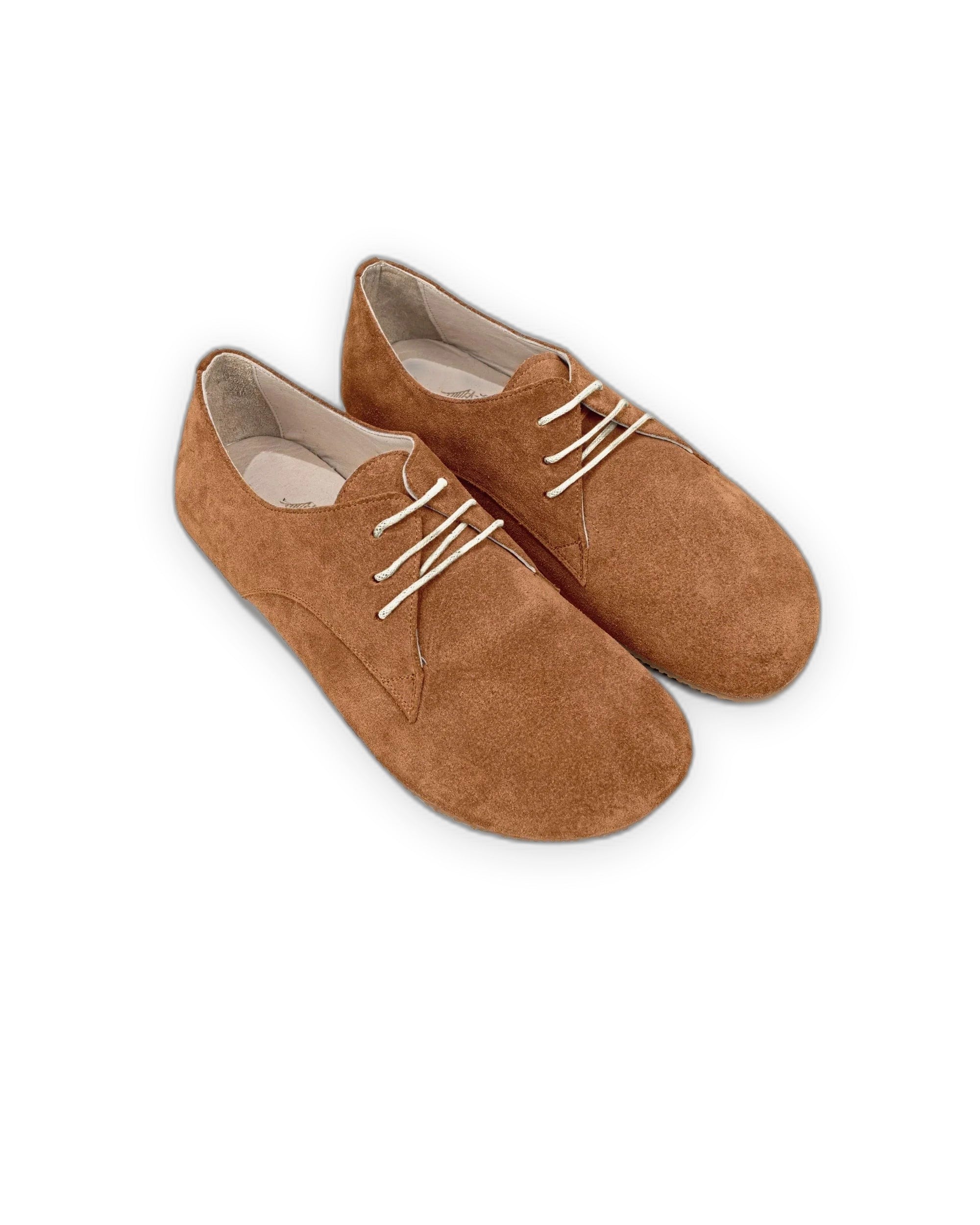
Put a wide, chunky trail sneaker next to a barefoot oxford in black calf leather, and nobody is going to clock them as the "same category" of shoe, even though both are zero-drop and wide in the toe box. The barefoot category covers an enormous range of silhouettes — the trick for a wedding is picking from the dressy end of that range, not the trail-running end.
What to Actually Look For
If you're shopping for a wedding, run every option through these four checks before anything else:
- Material. Smooth or suede leather reads as dressy. Mesh, canvas, and anything with visible technical stitching reads as athletic, even in a nice color.
- Color. Black, dark brown, tan, or a true metallic will coordinate with almost any wedding dress code. Save the bold color pairs for an everyday outfit — unless the dress code is a themed or colorful one, in which case a well-chosen bold shade can actually be a nice intentional touch.
- Silhouette. Oxfords, loafers, and simple ballet flats sit at the formal end. Low ankle boots can work for an autumn or evening wedding. Anything that looks like a trainer, even a very nice one, doesn't.
- Sole profile. A thin, barely-there sole disappears visually. That's actually one of the quiet advantages of barefoot shoes here — there's no thick foam wedge drawing the eye down to your feet.
For Her: Guest and Bridesmaid Options
If you're a guest, a bridesmaid, or just the person who has learned the hard way that heels and a three-hour ceremony-plus-reception don't mix, a simple leather ballet flat is the easiest swap. It reads as polished and intentional, not "comfort shoes I settled for," and the wide toe box means your feet aren't fighting the shoe by the time the first dance starts.
Barefoot oxfords also work beautifully with a suit-style bridesmaid look or a more tailored wedding guest outfit — they're not just a men's silhouette. If several of you are coordinating, a color-matched pair can double as the kind of small detail that shows up nicely in photos without anyone needing to ask where you got them.
For Him: Groom and Groomsmen Options
For the groom's party, a black or dark brown barefoot oxford covers almost every formal dress code and photographs exactly like a traditional dress shoe — because, from the outside, that's exactly what it is. For a slightly more relaxed or autumn wedding, a low barefoot Chelsea boot is a good middle ground between dressy and comfortable, especially for an outdoor or rustic venue. If the groomsmen want a unifying detail, the same color guide that works for bridesmaids has options on the men's side too.
Outdoor and Destination Weddings: Where Barefoot Shoes Actually Win
This is the scenario where barefoot shoes stop being just "the comfortable choice" and start being the genuinely better choice. A wide, stable base and a flexible sole that can actually feel and adapt to the ground underneath it is a real advantage on grass, gravel, cobblestones, or sand — all classic wedding-venue terrain that regular heels and stiff-soled dress shoes handle badly. You're less likely to sink, wobble, or roll an ankle walking across a lawn in low barefoot flats or boots than in almost anything else dressy.
It's also worth thinking about the whole day, not just the ceremony. If you're standing for photos, walking between venues, and then dancing for hours, a shoe that was comfortable sitting in a box at the store can still feel very different eight hours in. This is one of the few times "formal shoe" and "shoe you can actually move in all day" genuinely overlap.
A Few Practical Notes Before the Big Day
Don't buy your wedding shoes the week of the wedding and wear them for the first time at the venue. Even a well-fitted barefoot shoe benefits from a short break-in period — a few short walks around the house are usually enough, since there's no stiff structure to "wear down" the way there is with a traditional dress shoe, but your feet still appreciate the head start. Give yourself at least a week or two of buffer in case you need to size up, size down, or exchange a color.
If you're currently wearing cushioned heels or stiff dress shoes day to day and this will be your first time in something zero-drop, ease into it. Wear the shoes around the house, then for a short errand, before trusting them for a full wedding day on your feet.
Frequently Asked Questions
Can I wear barefoot shoes to a black-tie wedding?
A polished black leather oxford or a sleek loafer-style barefoot shoe can work for most black-tie-optional events. For a strict, traditional black-tie dress code, check with the couple or venue first, the same way you would with any shoe choice — the barefoot part isn't really the deciding factor, the formality of the silhouette is.
Will people actually notice I'm wearing barefoot or minimalist shoes?
Honestly, almost never — not if you've picked a dressy silhouette and color. Most people register "nice black shoes," not "wide toe box" or "zero drop." The wide toe box is noticeable up close if someone looks for it, but it reads as a roomier, more comfortable fit rather than an unusual one.
Are barefoot shoes actually good for a full night of dancing?
This is usually where people are pleasantly surprised. A flexible, wide-toe-box shoe tends to hold up better over hours of standing and dancing than a stiff dress shoe or a heel, simply because your foot isn't being squeezed or tipped forward the entire time.
What if the wedding has a specific color-coded dress code?
Stick to neutral leather tones (black, brown, tan) unless the dress code explicitly calls for a color, in which case a well-matched pair from a color guide can work in your favor rather than against you.
At the end of the day, the best wedding shoe is the one you forget you're wearing by the time the toasts start. If that means swapping heels or stiff oxfords for something with a wide toe box and a flexible sole, nobody at the reception is going to think twice — they'll just notice you're still smiling and still on the dance floor at the end of the night.